+91 9953 65 9594


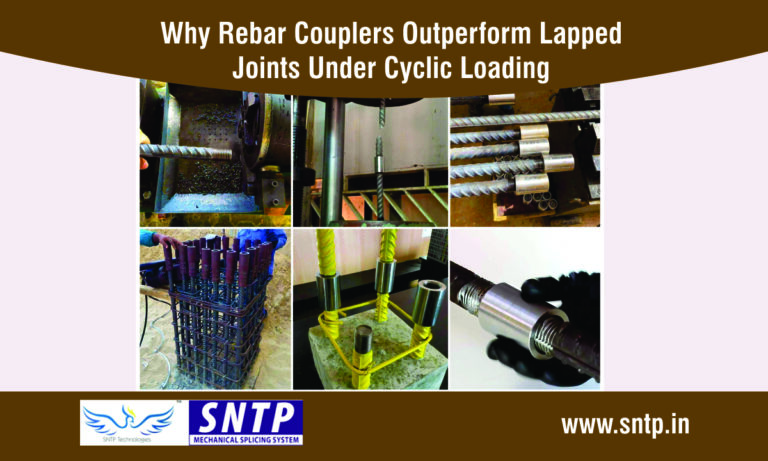
Why Rebar Couplers Outperform Lapped Joints Under Cyclic Loading
Modern RCC structures are no longer designed only for static loads. Buildings, bridges, metro systems, industrial plants, and high-rise towers are increasingly subjected to cyclic loading caused by earthquakes, wind forces, traffic movement, machinery vibrations, and thermal expansion. Under such conditions, the performance of reinforcement connections becomes critical.
Traditional lapped joints, though widely used in the past, were never engineered to handle repeated load reversals efficiently. In contrast, Rebar couplers—a mechanical splicing solution—have proven to deliver superior performance under cyclic loading. This article explains why rebar couplers outperform lapped joints when structures face repeated tension and compression cycles.
Understanding Cyclic Loading in RCC Structures
Cyclic loading refers to loads that:
- Act repeatedly over time
- Change direction (tension ↔ compression)
- Cause stress reversals in reinforcement
Common sources include:
- Earthquakes and aftershocks
- Wind-induced sway in tall buildings
- Moving vehicular loads on bridges
- Industrial machinery vibrations
- Temperature-induced expansion and contraction
Under cyclic loading, reinforcement joints must maintain continuity, ductility, and fatigue resistance—areas where lapped joints often struggle.
How Lapped Joints Behave Under Cyclic Loading
Lapped joints rely on bond strength between steel and concrete to transfer forces from one bar to another. While this works under static conditions, cyclic loading introduces several weaknesses:
1. Bond Degradation Over Time
Repeated stress reversals gradually weaken the bond between concrete and steel. Micro-cracks form around the lap zone, reducing friction and anchorage.
2. Slip Between Bars
Under cyclic tension and compression, bars in a lap splice tend to slip relative to each other. This slippage increases deformation and reduces stiffness.
3. Stress Concentration
Lap zones often experience uneven stress distribution. Under cyclic loading, this concentration accelerates fatigue and crack propagation.
4. Congestion and Poor Compaction
Lapped joints create heavy reinforcement congestion, which makes proper concrete compaction difficult. Poor compaction further weakens bond performance under repeated loading.
These factors explain why lapped joints are vulnerable in seismic and vibration-prone structures.
How Rebar Couplers Perform Under Cyclic Loading
Rebar couplers connect bars using direct mechanical engagement, independent of concrete bond. This fundamental difference makes couplers far more reliable under cyclic loading.
1. Direct Load Transfer Through Steel
Unlike lapped joints, couplers transfer load:
- Directly from one bar to the other
- Through steel-to-steel contact
- Without reliance on concrete bond
This ensures consistent performance even when surrounding concrete cracks under cyclic stress.
2. Superior Fatigue Resistance
Mechanical couplers are designed and tested to withstand:
- Repeated tension-compression cycles
- High-stress reversals
- Long-term fatigue loading
Laboratory and field tests consistently show that couplers maintain their strength even after thousands of load cycles.
3. Reduced Slip and Deformation
Properly installed rebar couplers eliminate bar slippage. This leads to:
- Better stiffness retention
- Lower residual deformation
- Improved overall structural response
Reduced deformation is crucial for controlling drift in high-rise buildings and bridges.
4. Uniform Stress Distribution
Couplers provide uniform stress transfer across the joint, reducing stress concentration points. This significantly delays fatigue damage and crack initiation.
Performance in Seismic Zones
Seismic forces are the most severe form of cyclic loading. Structures must not only resist collapse but also absorb and dissipate energy.
Why Couplers Excel in Earthquake Conditions
- They maintain reinforcement continuity even after concrete cracking
- They offer ductile behavior, allowing controlled deformation
- They prevent premature joint failure
- They perform consistently under load reversals
This is why rebar couplers are widely recommended in:
- Earthquake-prone regions
- High-rise buildings
- Critical infrastructure like hospitals, metros, and bridges
Energy Dissipation and Ductility
Ductility is essential in cyclic loading scenarios. A ductile structure:
- Absorbs energy
- Undergoes controlled deformation
- Avoids sudden brittle failure
Rebar couplers support ductile behavior by:
- Ensuring full bar strength continuity
- Avoiding bond-dependent failure mechanisms
- Allowing predictable plastic hinge formation away from joints
Lapped joints, on the other hand, often fail prematurely due to bond loss.
Long-Term Durability Under Repeated Loads
Cyclic loading is not limited to earthquakes. Even moderate loads, when repeated thousands of times, can cause fatigue failure.
Couplers Improve Long-Term Performance By:
- Preventing progressive bond deterioration
- Reducing micro-crack propagation at joints
- Maintaining load transfer capacity over time
This makes couplers ideal for:
- Bridges
- Flyovers
- Industrial floors
- Offshore and coastal structures
Construction Quality and Reliability
Large projects have shown that under cyclic loading:
- The weakest point often becomes the lap splice
- Mechanical couplers reduce variability in joint performance
Since couplers are factory-tested and standardized, they offer predictable behavior—an essential requirement in performance-based design.
Design and Code Compliance Advantages
Modern design codes increasingly recognize the limitations of lapped joints under cyclic loading. Many standards now:
- Restrict lap splicing in plastic hinge zones
- Recommend mechanical splicing in seismic regions
- Specify performance requirements for cyclic testing
Rebar couplers meet these advanced performance criteria more reliably than traditional lapping.
Economic Perspective Under Cyclic Loading
While couplers may have a higher upfront cost, they:
- Reduce repair and retrofit risks
- Lower long-term maintenance costs
- Minimize damage after seismic events
From a lifecycle cost perspective, couplers are a more economical choice in cyclic load environments.
Conclusion
Under cyclic loading, the difference between lapped joints and rebar couplers becomes unmistakably clear. Lapped joints depend heavily on concrete bond, which deteriorates under repeated load reversals. Rebar couplers, by contrast, provide direct mechanical continuity, superior fatigue resistance, reduced deformation, and consistent performance.
As structures grow taller, more complex, and more exposed to dynamic forces, rebar couplers clearly outperform lapped joints under cyclic loading. Their ability to maintain strength, ductility, and durability makes them an essential component of modern RCC construction—especially in seismic and vibration-prone environments.
Recent Posts

© Copyright 2017.SNTP All Rights Reserved.
Design & Developed By Star Web Maker