+91 9953 65 9594


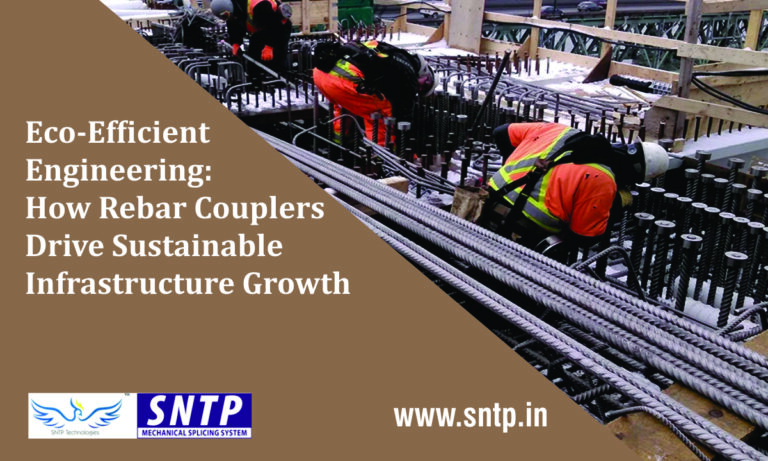
Eco-Efficient Engineering: How Rebar Couplers Drive Sustainable Infrastructure Growth
In a world driven by rapid urbanization and industrial expansion, the construction sector faces a dual challenge—building faster while staying sustainable. As global attention turns toward reducing carbon emissions and material waste, engineers and developers are rethinking traditional construction practices. One of the most impactful innovations leading this transformation is the rebar coupler—a compact yet powerful component revolutionizing the way reinforcement bars are connected in concrete structures.
Rebar couplers have emerged as a symbol of eco-efficient engineering, offering exceptional strength, reduced steel wastage, and a sustainable approach to infrastructure development. And at the forefront of this revolution stands SNTP Technologies®, India’s first BIS-certified manufacturer of rebar couplers, setting new standards for quality, efficiency, and environmental responsibility.
The Environmental Cost of Traditional Reinforcement
For decades, reinforcement bars in concrete structures have been joined using lapping, where two bars overlap for a considerable length and are tied together. While effective, this method is far from efficient.
Every lapped joint consumes an additional 40–50 times the diameter of the bar in overlapping steel—translating to massive material wastage on large-scale projects. Moreover, steel production itself is highly resource-intensive, accounting for nearly 8% of global carbon dioxide emissions. The excess steel required in lapped joints not only inflates project costs but also increases the environmental burden.
In dense reinforcement areas like columns, beams, and foundations, overlapping creates steel congestion, which hampers proper concrete flow and compaction. This not only affects structural integrity but also leads to higher rework and labor costs. Clearly, the traditional approach needs a modern, sustainable alternative.
Rebar Couplers: A Smarter Connection System
Rebar couplers, also known as mechanical splicing systems, are designed to connect two reinforcement bars end-to-end without overlapping. These precision-engineered devices use threaded, swaged, or compression fittings to create a mechanical bond that matches or exceeds the strength of the rebar itself.
By eliminating lapping altogether, rebar couplers offer a range of sustainability and performance benefits:
- Zero Steel Wastage: No need for overlapping lengths—every millimeter of steel is utilized effectively.
- Material Efficiency: Shorter or cut-length bars can be reused easily, reducing scrap generation.
- Reduced Carbon Footprint: Less steel usage translates directly into lower embodied carbon.
- Improved Concrete Quality: No congestion in reinforcement zones ensures uniform compaction and superior strength.
- Faster Construction: Simple installation speeds up project timelines and reduces on-site labor.
In essence, rebar couplers combine structural performance with sustainability, paving the way for a greener and more efficient construction ecosystem.
SNTP Technologies® — Leading the Green Reinforcement Revolution
Founded in 2015, SNTP Technologies® began with a visionary goal: to introduce world-class rebar connection systems in India that meet international standards of safety, performance, and sustainability.
On 6th May 2024, SNTP achieved a historic milestone—becoming the first Indian company to receive certification from the Bureau of Indian Standards (BIS) for its rebar couplers. This recognition, conferred by the Ministry of Consumer Affairs, marked a major leap forward for India’s reinforcement industry, officially establishing SNTP as a benchmark of trust, precision, and innovation.
The company’s advanced manufacturing facility operates under ISO 9001:2015-certified processes, ensuring consistent quality and traceability across every product. Each coupler is engineered to deliver high tensile strength, perfect alignment, and zero tolerance for defects, making them ideal for critical infrastructure applications.
From bridges, metros, and tunnels to high-rise towers and industrial complexes, SNTP Technologies® has been a trusted partner in shaping India’s modern skyline—while keeping sustainability at its core.
Driving Sustainability Through Engineering Excellence
SNTP’s rebar couplers are more than just mechanical connectors—they are an embodiment of eco-efficient engineering. Here’s how they contribute to sustainable infrastructure growth:
- Reduced Steel Consumption
By eliminating the need for overlapping lengths, rebar couplers help cut down steel usage by up to 30% in some projects. This directly reduces the carbon emissions associated with steel manufacturing and transportation. - Waste Minimization and Material Reuse
The precision of SNTP couplers allows for shorter offcuts and leftover bars to be repurposed, minimizing scrap metal waste and promoting circular resource utilization. - Energy and Time Savings
The easy installation and compact design of couplers reduce on-site labor and equipment energy usage. Faster project completion also means lower overall energy consumption on construction sites. - Enhanced Structural Durability
SNTP’s BIS-certified couplers deliver superior load transfer and seismic resistance, leading to longer-lasting structures that require fewer repairs and replacements over time—further conserving resources. - Support for Green Certifications
Construction projects that adopt rebar couplers can earn additional sustainability points in green rating systems like LEED (Leadership in Energy and Environmental Design) and IGBC (Indian Green Building Council) certifications.
Real-World Applications: Building the Future Responsibly
SNTP’s rebar couplers have been successfully implemented across diverse sectors that define India’s infrastructural progress:
- Bridges and Flyovers: Strength and reliability under heavy dynamic loads.
- Metro and Rail Projects: Space efficiency and quick installation in congested urban environments.
- High-Rise Buildings: Superior load-bearing capacity for vertical structures.
- Tunnels and Dams: Durability in challenging conditions with enhanced safety.
- Industrial Plants: Precision and consistency for critical reinforcement applications.
Each of these projects reflects SNTP’s core values—strength, speed, and standardization—while contributing to a more sustainable built environment.
The Bigger Picture: Sustainability Beyond Materials
Sustainability isn’t just about reducing material waste—it’s about redefining engineering practices to create a long-term positive impact. SNTP Technologies® understands that sustainable growth requires innovation at every level—from product design to process optimization and customer collaboration.
By promoting eco-efficient rebar connection systems, SNTP is actively helping India align with global sustainability goals such as Net Zero Emissions, Circular Economy, and the United Nations Sustainable Development Goals (SDGs).
In doing so, the company not only strengthens structures but also strengthens India’s commitment to a greener, cleaner, and more resilient future.
Conclusion
As the demand for smarter, stronger, and more sustainable infrastructure rises, the role of rebar couplers becomes increasingly vital. These compact connectors symbolize the future of eco-efficient engineering, where every joint represents a step toward reduced wastage, optimized performance, and responsible construction.
Through its BIS-certified rebar couplers, SNTP Technologies® continues to lead the charge toward sustainable infrastructure development in India and beyond. By integrating innovation, precision, and environmental stewardship, SNTP is redefining how the world builds—stronger, faster, and greener.
In the evolving landscape of modern construction, rebar couplers aren’t just connecting steel—they’re connecting the world to a sustainable tomorrow.
Recent Posts



© Copyright 2017.SNTP All Rights Reserved.
Design & Developed By Star Web Maker