+91 9953 65 9594


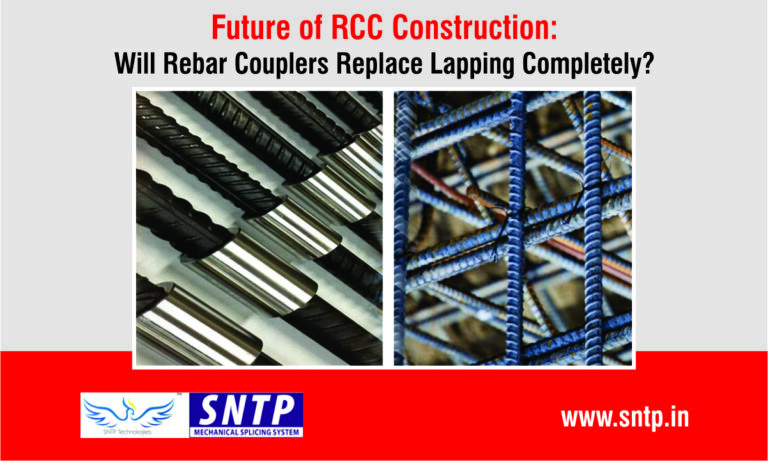
Future of RCC Construction: Will Rebar Couplers Replace Lapping Completely?
Reinforced Cement Concrete (RCC) construction has undergone tremendous evolution over the past few decades. From traditional tying and lapping systems to advanced mechanical splicing methods, engineering practices have continuously adapted to improve strength, durability, and construction speed. Today, rebar couplers—a modern alternative to lapping—are gaining widespread acceptance across infrastructure projects, high-rise buildings, metro systems, and bridges. These small yet powerful connectors are reshaping the future of RCC work.
The big question many engineers and contractors are asking is: Will rebar couplers replace traditional lapping completely?
To understand this, it’s crucial to examine the limitations of lapping, the advantages of couplers, and the future direction of global construction trends.
The Limitations of Lapping in RCC Construction
Lapping has been the most common reinforcement jointing method for decades, but it has several inherent drawbacks:
1. High Steel Wastage
In lapping, two rebars are overlapped for 40–50 times the diameter of the bar.
This can result in:
- Excessive material usage
- Increased project cost
- Massive waste in large-scale projects
For high-diameter bars (like 25mm, 28mm, or 32mm), the wastage becomes even more significant.
2. Reduced Structural Efficiency
Lapping creates a “weak zone” in RCC because the load transfer is dependent on friction and bond strength. If concrete quality or compaction is compromised, failure may occur at the splice.
3. Congestion During Reinforcement
Lapping multiple bars in beams or columns leads to:
- Heavy congestion in reinforcement cages
- Difficulty in placing and vibrating concrete
- Increased risk of voids and honeycombing in columns
This affects both structural strength and surface finish.
4. Not Ideal for High-Strength, High-Rise Projects
As buildings grow taller and infrastructure becomes more demanding, lapping becomes less efficient. It simply cannot meet the modern engineering requirements of mega-structures.
These limitations highlight why the industry is shifting toward rebar couplers.
Why Rebar Couplers Are Gaining Massive Popularity
Rebar couplers eliminate the disadvantages of lapping by creating a direct mechanical connection between reinforcement bars. They are engineered to transfer loads more efficiently and reduce congestion within the structure.
Key Benefits Driving Adoption:
1. Zero Steel Wastage
Couplers require only a small threaded length of the rebar—no long laps, no unnecessary material.
This results in:
- Cost savings
- Leaner construction
- Better material utilization
2. Superior Structural Strength
Couplers create a 100% mechanical interlock between bars.
Benefits include:
- Superior tension and compression performance
- Consistent load transfer
- No dependence on concrete quality around the joint
They perform exceptionally well in seismic zones where reliable splicing is critical.
3. Reduced Reinforcement Congestion
One of the biggest advantages of couplers is the clean and organized reinforcement layout. With no overlapping bars, there is:
- Better space for concrete flow
- Improved compaction
- Reduced voids
- Stronger column and beam cores
4. Faster Construction Speed
Couplers significantly reduce labor time because:
- Threading and installation are straightforward
- No long laps to tie
- Ideal for high-rise towers with tight schedules
By optimizing the workflow, contractors achieve faster project delivery.
5. Compatibility With All Bar Diameters
Large diameter bars, especially above 25mm, are difficult to lap and often fail due to poor bond strength.
Couplers solve this problem completely.
Global Market Trends: Couplers Are Becoming the New Standard
Across developed countries like the US, UK, UAE, Qatar, Singapore, and Japan, rebar couplers have already become the preferred method of splicing.
Key trends shaping the future:
- Rising adoption of IS 16172 and international coupler standards
- Preference for mechanical splicing in government infrastructure contracts
- Increasing use of large-diameter rebars in high-rise projects
- Growing awareness about sustainable and waste-free construction
- Advanced automation in rebar threading machines
- Contractors shifting towards quality-driven construction practices
These trends indicate that couplers are not just a temporary improvement—they are a structural necessity for the next generation of RCC buildings.
Will Rebar Couplers Replace Lapping Completely in the Future?
1. In High-Rise & Mega Projects — Yes, Almost Completely
Tall buildings, metro stations, bridges, sea links, flyovers, and industrial projects prefer couplers because:
- They provide reliable performance
- They reduce congestion
- They support heavy load requirements
In these sectors, lapping will likely become obsolete.
2. In Government Infrastructure — Strong Shift Toward Couplers
Many global and Indian government bodies are mandating mechanical splicing for specific structures to ensure safety and strength.
For example:
- Metro rail projects
- Highway bridges
- Tunnel work
- Coastal structures
This sector will drive near-complete adoption of couplers.
3. In Small Residential Projects — Lapping Will Still Exist
For low-rise residential buildings and local constructions, lapping might remain in use due to:
- Lower engineering oversight
- Cost sensitivity
- Smaller bar diameters
However, as awareness increases and costs reduce, even this segment will shift toward couplers.
Challenges Slowing Down Full Replacement
Despite the benefits, a few factors still prevent couplers from replacing lapping everywhere:
1. Higher Initial Costs
Although couplers save steel in the long run, the initial purchase cost may discourage small contractors.
2. Need for Skilled Labor
Threading and correct installation require trained technicians.
Unskilled labor can make errors that compromise joint strength.
3. Availability in Remote Areas
Tier-3 and rural markets may not have immediate access to quality mechanical splicing systems.
The Future: A Hybrid Transformation Period
We are currently in a transition era.
Here’s the likely direction:
Short-Term (2025–2030):
- Rapid adoption in infrastructure and high-rise construction
- Lapping still used for local residential work
- Increasing training for coupler installation
Long-Term (2030–2040):
- Couplers may become the primary splicing method in most RCC structures
- Lapping usage may reduce to only small, non-critical applications
- New technologies will make couplers even more affordable and easy to install
In short, couplers will not replace lapping “overnight,” but their dominance is inevitable.
Conclusion
Rebar couplers are transforming RCC construction by offering strength, efficiency, sustainability, and ease of installation. While lapping will still remain in small-scale projects for some time, the shift toward mechanical splicing is undeniable—especially in high-rise buildings and infrastructure development.
The future of RCC construction will rely heavily on couplers as they ensure:
- Superior structural performance
- Zero material wastage
- Faster project timelines
- Cleaner and safer construction practices
As standards evolve and contractors adopt modern techniques, rebar couplers are set to become the new industry norm, gradually replacing traditional lapping in most major applications.
Recent Posts





© Copyright 2017.SNTP All Rights Reserved.
Design & Developed By Star Web Maker