+91 9953 65 9594


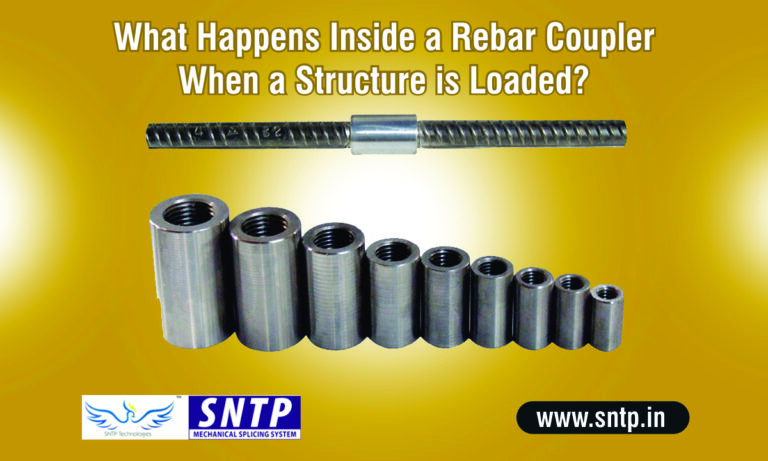
What Happens Inside a Rebar Coupler When a Structure Is Loaded?
When we look at a reinforced concrete building, bridge, or foundation, most of the important work happening inside the structure cannot be seen. Concrete takes care of much of the compression, while steel reinforcement helps the structure handle tension and other forces. But when reinforcement bars need to be connected, the quality of that connection becomes just as important as the bars themselves.
This is where Rebar Couplers play an important role.
A rebar coupler creates a mechanical connection between two reinforcement bars. When a structural member is loaded, forces move through the reinforcement and reach this connection. The coupler then transfers the force from one bar to the other so that reinforcement can continue working as a single system.
But what actually happens inside the coupler when the structure is under load? Understanding this process gives engineers, contractors, and construction teams a better idea of why coupler design, quality, installation, and testing matter.
How Load Reaches a Rebar Coupler
Imagine two reinforcement bars connected end-to-end using a mechanical coupler. Before the structure is loaded, the bars and coupler form one continuous reinforcement connection.
Once the structure starts carrying a load, forces develop within the reinforcement. These forces travel along the first bar until they reach the coupler.
The coupler receives this force through its connection with the bar. It then transfers the force through its own body and mechanical mechanism before passing it into the second reinforcement bar.
In simple terms, the load path looks like this:
First Rebar → Coupler Connection → Coupler Body → Coupler Connection → Second Rebar
The purpose of the connection is to transfer the required force without becoming a weak point in the reinforcement system.
The exact way this happens depends on the design of the coupler. Threaded couplers, bolted couplers, and other mechanical systems use different methods to secure and connect reinforcement bars.
What Happens When the Rebar Is Under Tension?
Tension is one of the most important forces considered in reinforced concrete construction.
For example, when a beam bends under a load, tension develops in certain reinforcement bars. If a coupler is located along that reinforcement line, the tensile force eventually reaches the connection.
The first bar is effectively trying to pull away from the second bar. The mechanical connection prevents this separation and transfers the force across the joint.
A properly designed connection should be capable of transferring the required force without excessive movement or premature failure.
This is one of the main reasons Rebar Couplers used in structural applications are subjected to mechanical testing. Engineers need confidence that the connection can perform under the loads expected in the actual structure.
How Threaded Rebar Couplers Transfer Load
Threaded couplers are widely used because they provide a direct mechanical connection between reinforcement bars.
In a threaded system, the ends of the rebars are prepared with threads that match the internal threads of the coupler. The bars are then inserted and engaged according to the manufacturer's installation requirements.
When the connected reinforcement is loaded, the threads resist the force attempting to separate the bars. The force is transferred through the threaded engagement and the coupler body into the adjoining reinforcement.
This makes thread quality extremely important.
If the threads are damaged, poorly prepared, contaminated, or not engaged to the required depth, the connection may not perform as intended. Proper bar preparation and installation checks are therefore essential.
How Bolted Rebar Couplers Work Under Load
Bolted rebar couplers use a different mechanical arrangement.
Instead of relying on threaded ends, the reinforcement bars are placed inside the coupler and secured using bolts. The bolts are tightened according to the manufacturer's specified procedure.
Once installed correctly, the connection holds the reinforcement in position and provides the required mechanical load-transfer path.
When the structure is loaded, the bars attempt to move relative to each other. The coupler's mechanical gripping and locking mechanism resists this movement and transfers the force between the bars.
The exact mechanism can differ from one product to another. Therefore, contractors should always follow the manufacturer's installation instructions rather than assuming that every bolted coupler can be installed in the same way.
What Happens Inside the Coupler Body?
The coupler body is not just a protective sleeve. It is an engineered component that forms part of the load path.
When force reaches the connection, stress develops within the coupler. Its material strength, dimensions, internal geometry, and manufacturing accuracy all affect how the force is distributed.
A properly engineered coupler is designed to handle the required forces while maintaining the connection between the reinforcement bars.
This is why the manufacturing process matters. A coupler that looks acceptable from the outside may still have problems if its dimensions, material properties, threads, or internal surfaces do not meet the required specifications.
For critical construction projects, product quality should therefore be supported by appropriate testing and documentation.
What Happens When the Structure Is Under Compression?
Reinforcement can also experience compression depending on its location and the type of structural member.
Under compression, the connected bars are pushed toward one another rather than pulled apart.
The coupler must continue to provide a stable load path between the two reinforcement bars. Its design needs to accommodate the expected compressive forces without creating an unintended weak point.
The behaviour will depend on the type and design of the mechanical splice. For this reason, engineers should select a coupler based on the actual structural requirements rather than assuming that one product is suitable for every application.
What Happens During Repeated Loading?
Not every structure experiences only one-time or static loading.
Bridges experience repeated traffic. Tall buildings respond to wind movement. Industrial structures can experience vibration from machinery. Structures designed for seismic conditions may experience repeated changes between tension and compression.
Under these conditions, the connection may experience repeated loading cycles.
This is where properties such as fatigue resistance, ductility, cyclic performance, and slip become important.
A suitable mechanical splice should have performance data appropriate for the conditions in which it will be used. For demanding structures, engineers should review the relevant test results and project requirements before selecting the connection.
Why Slip Matters in a Mechanical Connection
Slip refers to movement that can occur at a reinforcement connection when it is subjected to load.
A certain amount of movement may be associated with a particular connection system, but excessive slip can affect the behaviour of the structural member.
This is why slip performance can be an important part of mechanical splice testing.
Installation also has a direct effect. If a threaded bar is not properly engaged or a bolted connection is not installed according to the required procedure, the connection may not provide the expected performance.
In other words, a high-quality product still requires high-quality installation.
Does Concrete Affect the Performance of a Rebar Coupler?
Yes. Although a coupler creates a mechanical connection between reinforcement bars, it still forms part of a reinforced concrete system.
Concrete provides confinement around the reinforcement and contributes to the overall behaviour of the structural member. The location of the coupler, surrounding reinforcement, concrete cover, and structural detailing must therefore be considered together.
One advantage of mechanical splicing is that it can reduce the need for long overlapping reinforcement. This can create more usable space around heavily reinforced areas and make concrete placement easier.
However, this does not mean that coupler placement can be decided without structural consideration. The connection should always be incorporated into the reinforcement detailing.
Why Coupler Location Is Important
The same coupler may behave differently depending on where it is used and what forces are expected at that location.
Columns, beam-column joints, shear walls, foundations, and other heavily loaded elements may have specific detailing requirements.
Before using a coupler, the project team should consider:
- Expected structural loads
- Reinforcement diameter
- Available installation space
- Structural detailing
- Seismic requirements
- Applicable standards
- Manufacturer recommendations
Correct placement helps ensure that the connection works as intended within the complete structural system.
Installation Has a Direct Impact on Performance
One of the biggest mistakes on construction sites is treating installation as a minor task.
The actual performance of Rebar Couplers depends heavily on how they are installed.
Depending on the coupler type, site teams may need to verify:
- Correct rebar diameter
- Proper bar preparation
- Correct insertion depth
- Thread engagement
- Bolt tightening
- Bar alignment
- Coupler condition
- Installation records
These checks help ensure that the connection installed on site matches the conditions under which the product was designed and tested.
Why Testing Is Important Before Use
A professional construction project should not select a mechanical splice simply because it looks strong or is available at a lower price.
Testing provides evidence of how the connection behaves under controlled conditions.
Depending on the application and applicable requirements, testing may cover tensile strength, yield performance, slip, ductility, fatigue, or cyclic loading.
The required level of testing depends on the project, structural design, and relevant standards.
This information helps engineers make an informed decision about whether a particular coupler is appropriate for the intended application.
The Real Meaning of Load Transfer
The most important thing to understand is that a coupler does not carry the load in isolation.
The reinforcement bar, coupler, concrete, structural detailing, and installation quality all work together.
When the structure is loaded, the force needs to move through this entire system in a controlled manner. If the connection is properly designed and installed, the coupler allows the reinforcement to maintain continuity across the joint.
That is the real purpose of mechanical splicing.
Conclusion
When a reinforced concrete structure is loaded, a Rebar Coupler becomes an active part of the reinforcement load path. The force travels from one reinforcement bar into the mechanical connection, through the coupler, and then into the adjoining bar.
Threaded systems transfer force through their mechanical thread engagement, while bolted systems use their specific gripping and locking mechanisms. The connection must be capable of handling the required tension, compression, and, where applicable, repeated or cyclic loading.
However, the performance of a coupler does not depend on the product alone. Correct selection, manufacturing quality, structural detailing, proper installation, inspection, and suitable testing all play a role.
For engineers and contractors, understanding what happens inside a coupler under load makes one thing clear: a mechanical splice should be treated as an engineered structural connection, not simply as a way to join two rebars. When the right coupler is selected and installed correctly, it can provide reliable reinforcement continuity for demanding RCC construction projects.
Recent Posts

© Copyright 2017.SNTP All Rights Reserved.
Design & Developed By Star Web Maker