+91 9953 65 9594


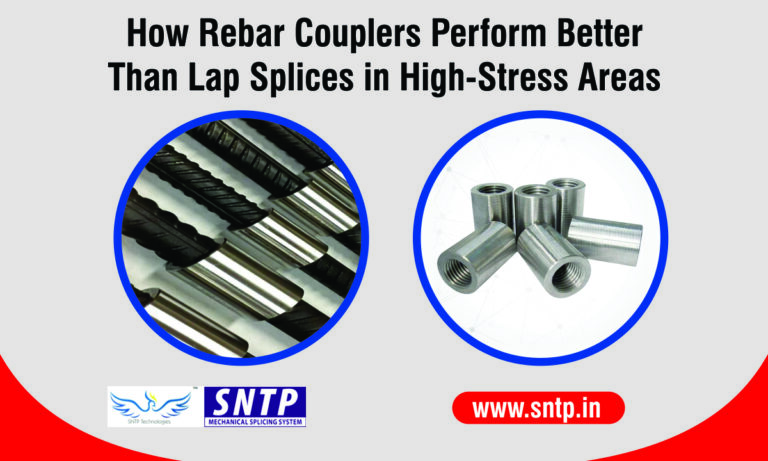
How Rebar Couplers Perform Better Than Lap Splices in High-Stress Areas
In reinforced concrete construction, the connection between reinforcement bars plays a major role in determining the strength and durability of a structure. For decades, lap splicing was the standard method used to join rebars. However, as construction projects became taller, heavier, and more technically demanding, the limitations of lap splices started becoming more visible—especially in high-stress areas.
Today, Rebar couplers are increasingly preferred in critical structural zones because they offer stronger load transfer, reduced congestion, and more reliable performance under extreme conditions. From high-rise buildings and bridges to metro systems and industrial plants, engineers are choosing mechanical splicing systems to improve structural safety and efficiency.
This article explains how rebar couplers perform better than lap splices in high-stress areas and why they are becoming the preferred solution in modern RCC construction.
Understanding High-Stress Areas in RCC Structures
High-stress areas are parts of a structure where reinforcement experiences heavy tension, compression, shear, or cyclic loading. These zones are critical because failure here can affect the stability of the entire structure.
Common high-stress areas include:
- Beam-column joints
- Transfer beams
- Shear walls
- Bridge decks
- Seismic zones
- Raft foundations
- Industrial floors under heavy machinery
- High-rise core walls
In such areas, reinforcement joints must maintain maximum strength and continuity.
The Limitations of Lap Splices in High-Stress Zones
Lap splicing works by overlapping two rebars over a specified length so the load transfers through the surrounding concrete bond. While this method may work in low-stress applications, it has several disadvantages in critical zones.
1. Dependence on Concrete Bond
Lap splices rely heavily on:
- Concrete quality
- Proper compaction
- Adequate cover
- Bond strength between steel and concrete
In high-stress conditions, cracks may develop around the lap zone, weakening the bond and reducing load transfer efficiency.
2. Reinforcement Congestion
Lap lengths increase the amount of steel inside beams and columns. In heavily reinforced areas, this creates congestion that:
- Restricts concrete flow
- Makes vibration difficult
- Causes honeycombing and voids
Poor compaction further reduces structural reliability.
3. Uneven Load Transfer
Lap splices do not transfer load directly from one bar to another. Instead, force passes through concrete, which can create stress concentration and inconsistent performance under heavy loading.
4. Reduced Performance Under Cyclic Loads
In seismic or vibration-prone structures, repeated stress reversals weaken the bond in lap splices. Over time, this can lead to slippage, cracking, and joint failure.
How Rebar Couplers Solve These Problems
Rebar couplers create a direct mechanical connection between reinforcement bars. Unlike lap splices, they do not depend on concrete bond for load transfer.
This gives them a major advantage in high-stress structural zones.
1. Direct Load Transfer Improves Strength
The biggest advantage of rebar couplers is direct steel-to-steel load transfer.
How It Helps:
- Loads move directly through the coupler
- No dependency on surrounding concrete
- Better continuity of reinforcement
- Higher joint efficiency
This creates a stronger and more reliable reinforcement connection.
In high-stress areas, direct load transfer is critical for maintaining structural integrity.
2. Reduced Congestion Leads to Better Concrete Quality
Rebar couplers eliminate the need for long overlap lengths. This significantly reduces reinforcement congestion.
Benefits Include:
- Better concrete flow
- Easier vibration and compaction
- Reduced honeycombing
- Improved structural density
In beam-column joints and shear walls where space is limited, this advantage becomes extremely important.
3. Superior Performance in Seismic Zones
Earthquakes create cyclic loading where reinforcement experiences repeated tension and compression.
Rebar couplers perform better because:
- They reduce bar slippage
- They maintain reinforcement continuity
- They provide stable mechanical engagement
- They improve ductility and energy dissipation
Modern seismic design often recommends mechanical splicing systems in critical zones because lap splices may fail under repeated stress reversals.
4. Higher Tensile Strength and Reliability
Quality rebar couplers are designed to achieve:
- Full bar strength
- Consistent tensile performance
- Reliable mechanical continuity
Lap splices, however, may fail if:
- Concrete strength is poor
- Lap length is insufficient
- Reinforcement placement is incorrect
Couplers reduce these risks significantly.
5. Better Fatigue Resistance
Structures like bridges, flyovers, and industrial foundations are exposed to continuous dynamic loads.
Rebar couplers handle fatigue better because:
- Stress distribution is more uniform
- Mechanical grip remains stable over time
- Bond deterioration is minimized
This improves long-term structural durability.
6. Faster and More Efficient Construction
In large infrastructure projects, time is critical. Rebar couplers simplify reinforcement work by:
- Reducing steel handling
- Eliminating lengthy overlap arrangements
- Improving installation efficiency
This allows faster reinforcement placement and shorter construction cycles.
7. Improved Structural Design Flexibility
Couplers allow engineers to design reinforcement layouts more efficiently.
Advantages include:
- Cleaner reinforcement detailing
- Easier bar placement in confined zones
- Better adaptability for phased construction
This flexibility is valuable in modern high-rise and infrastructure projects.
8. Reduced Steel Consumption
Lap splices require additional bar length, increasing steel usage.
Rebar couplers reduce wastage by:
- Eliminating long lap lengths
- Optimizing reinforcement quantity
- Lowering material handling costs
In large projects, this creates major cost savings.
Real-World Applications Where Couplers Perform Better
Rebar couplers are widely preferred in:
- High-rise towers
- Metro rail systems
- Bridges and flyovers
- Industrial plants
- Nuclear structures
- Offshore projects
- Earthquake-resistant buildings
These structures demand high-performance reinforcement connections that lap splices cannot always provide reliably.
Why Engineers Are Shifting Toward Rebar Couplers
The construction industry is moving toward:
- Stronger structures
- Faster project execution
- Sustainable construction practices
- Performance-based engineering
Rebar couplers support all these goals by providing:
- Higher structural reliability
- Better performance in critical zones
- Reduced material waste
- Improved construction quality
As a result, they are becoming the preferred reinforcement joining method for modern RCC projects.
Conclusion
In high-stress areas, the quality of reinforcement connections directly affects structural safety and long-term performance. While lap splices have been used for decades, they come with limitations related to congestion, bond dependency, fatigue resistance, and uneven load transfer.
Rebar couplers overcome these challenges by creating direct mechanical continuity between bars. They offer superior tensile strength, better seismic performance, reduced congestion, improved durability, and faster construction efficiency.
For modern RCC structures exposed to heavy loads, dynamic forces, and demanding design conditions, rebar couplers clearly perform better than traditional lap splices. As construction standards continue to evolve, mechanical splicing systems are becoming an essential part of safer and more efficient structural engineering.
Recent Posts

© Copyright 2017.SNTP All Rights Reserved.
Design & Developed By Star Web Maker